 Fiber addicts attempting to load 500 lbs of fiber into a van. Photo from the fiber shop in Japan called Spinhouse. Its magazine is called Spinnuts.
Friday, March 30, 2007
In May: the face of things to come
The Maryland Sheep and Wool Festival takes place (as if everyone didn't know already!) on the first full weekend of May.
 Fiber addicts attempting to load 500 lbs of fiber into a van. Photo from the fiber shop in Japan called Spinhouse. Its magazine is called Spinnuts.
Fiber addicts attempting to load 500 lbs of fiber into a van. Photo from the fiber shop in Japan called Spinhouse. Its magazine is called Spinnuts.


Monday, March 19, 2007
Charkhas for Ethiopia
I returned from a Youth and AIDS meeting in Johannesburg last week and found this email from one of the Ethiopian participants I met there. His name is Nibretie, a program officer from a UN agency in Addis Ababa. He wrote:
Dear Therese,
Thank you for all your logistical support for the Regional Consultation in South Africa.
Please advise how we should start the project you told me last time to support women in spinning and weaving. Maybe you could send me the type of materials that could be made available so that I can discuss the issue with my colleagues and partners?
As you know, there are a number of destitute women who need to be supported to improve their livelihood. There are also sex workers and women living with HIV/AIDS who badly need such support.
Thank you and kind regards,
Nibretie
Today, as I was sipping coffee at the office cafeteria after lunch, who should I see but Nibretie, in Washington for a training course. He was surpised to see me as well as he didn't think I was based in Washington.
Now I have to quickly put together something for Nibretie to take back to Addis. Fortunately, I still have one book charkha at home. I've just ordered a DVD copy of "Basic Techniques and Charkha Proficiency" by Eileen Hallman to serve as a manual and I hope it arrives before he leaves end of next week.
Today I also placed an order for a Babe charkha and Pinkie from Nels Wiberg of Babe's Fiber Garden. The Babe will go to Ethiopia, while the Pinkie will go to Mali. I have a standing request from Korotimi of the Sinigessigui guild in Ségou, Mali, for a Pinkie.
Previously, I gave Sinigessigui four sets of handcarders and four book charkhas. At that time, I didn't know the Malians knew how to use spinning wheels so I brought only one Pinkie which went to the Nieleni guild in the same city. Korotimi has since, checked out the Pinkie at their sister guild and I got an email saying, yes, they are interested in receiving one.
Dear Therese,
Thank you for all your logistical support for the Regional Consultation in South Africa.
Please advise how we should start the project you told me last time to support women in spinning and weaving. Maybe you could send me the type of materials that could be made available so that I can discuss the issue with my colleagues and partners?
As you know, there are a number of destitute women who need to be supported to improve their livelihood. There are also sex workers and women living with HIV/AIDS who badly need such support.
Thank you and kind regards,
Nibretie
Today, as I was sipping coffee at the office cafeteria after lunch, who should I see but Nibretie, in Washington for a training course. He was surpised to see me as well as he didn't think I was based in Washington.
Now I have to quickly put together something for Nibretie to take back to Addis. Fortunately, I still have one book charkha at home. I've just ordered a DVD copy of "Basic Techniques and Charkha Proficiency" by Eileen Hallman to serve as a manual and I hope it arrives before he leaves end of next week.
Today I also placed an order for a Babe charkha and Pinkie from Nels Wiberg of Babe's Fiber Garden. The Babe will go to Ethiopia, while the Pinkie will go to Mali. I have a standing request from Korotimi of the Sinigessigui guild in Ségou, Mali, for a Pinkie.
Previously, I gave Sinigessigui four sets of handcarders and four book charkhas. At that time, I didn't know the Malians knew how to use spinning wheels so I brought only one Pinkie which went to the Nieleni guild in the same city. Korotimi has since, checked out the Pinkie at their sister guild and I got an email saying, yes, they are interested in receiving one.
Sunday, March 18, 2007
Midian's Troll Umbrella
The gigantic parasol that I saw at the Filature Houard showroom reminded me of the work of my Swiss friend, Midian.
Midian is a fellow spinner. She is also a fabulous lace knitter who specializes in shawls, but her parasol creation is nothing less than breath-taking.

Midian calls it the troll umbrella, after the Scandinavian folklore of supernatural beings thought of as giants (or sometimes, dwarfs). It is an umbrella with 10 panels fitted over the frame of an antique one that she restored.


See Midian's home -- which is wired with cameras -- here. The interior evokes the same romantic character as knitted lace.
Midian is a fellow spinner. She is also a fabulous lace knitter who specializes in shawls, but her parasol creation is nothing less than breath-taking.

Midian calls it the troll umbrella, after the Scandinavian folklore of supernatural beings thought of as giants (or sometimes, dwarfs). It is an umbrella with 10 panels fitted over the frame of an antique one that she restored.


See Midian's home -- which is wired with cameras -- here. The interior evokes the same romantic character as knitted lace.
Monday, March 12, 2007
Filature Houard
This is the famous French yarn manufacturer I discovered through Laine Zinzin. It's located about an hour or so from Montpellier and Toulouse, or somewhere between Provence (South) and the Pyrénées (Southwest). If you are in the area and driving around, don't fail to visit the factory showroom because I've heard the company is in financial trouble, which is distressing. In fact, I can no longer access either of its two websites.

The store window from inside.

Scenes from the store.


An umbrella made of yarn.

Mill ends on the mezzanine floor.


The cashier asked if I was a weaver and I answered "no" and that puzzled her. So I explained that I'm a spinner. She still looked puzzled. I further explained that I use their yarn to ply with mine and mentioned to her that spinning in the US is "tres tendance" -- very trendy. She did mention that there was a lady who would come to the shop from time to time and buy lots of cones to send to friends in the US. As some of us know, that lady is none other than Laine Zinzin herself.

My modest loot from the store and the upstairs outlet. There was so much stuff in the outlet section that it took me no less than two hours to find just a few cones that I liked. You really have to dive into the corral of mill ends.


The store window from inside.

Scenes from the store.


An umbrella made of yarn.

Mill ends on the mezzanine floor.


The cashier asked if I was a weaver and I answered "no" and that puzzled her. So I explained that I'm a spinner. She still looked puzzled. I further explained that I use their yarn to ply with mine and mentioned to her that spinning in the US is "tres tendance" -- very trendy. She did mention that there was a lady who would come to the shop from time to time and buy lots of cones to send to friends in the US. As some of us know, that lady is none other than Laine Zinzin herself.

My modest loot from the store and the upstairs outlet. There was so much stuff in the outlet section that it took me no less than two hours to find just a few cones that I liked. You really have to dive into the corral of mill ends.

Friday, February 16, 2007
Yarn Invasion of the Alien Planet
Here is my submission to The Yarn Museum in the "Surreal" section. Thanks to Adrian of helloyarn for photographing tips.


Wednesday, February 14, 2007
Valentine à la française
This is the day I get to open my exchange gift from Le Forum de Filage. My marraine (godmother) is Carine from Belgium whom I met in France last September. As you will see in the following photos, Carine put a lot of effort, care and stuff in the package. The idea behind the exchange was to gift a filleul (godchild) one's handspun, an interpretation of the theme "le feu couve sous la glace" -- fire sits under ice, referring to Red Hot Day in the midst of Winter. The sender was also to add one's regional specialties and other goodies. The cream on top of my marvelous package was Carine's handspun: very finely spun and extremely balanced yarn only in the softest wool fiber. Merci, Carine!


Saturday, February 10, 2007
Natasha Fialkov, you're my hero!
Armed with the dishwasher photo uploaded by Tala of Black Cat and Handspun, I followed the 5000-word instructions of my fellow Camp Pluckyfluff alumna, Natasha, for dishwasher dyeing.

Here is my succinct rendition:
Fill the zipper freezer bag with water, soak in the fiber, squish until the fiber looks transparent. Squeeze and pour out the water. Mix the dye and vinegar, pour into the bag. Press to distribute the dye. Zip to just 1/4 inch to the end. Place in the dishwasher and run the longest and hottest cycle (no scrub) and heat dry.
I shared this idea with the Euro spinners on the French Tricofolk forum and they thought the wool would felt. So, I tried it myself using normal cycle, no pot and pan scrub. While I was able to card 100 percent of the fiber -- which meant it didn't felt -- I did have to open up the fibers at the end. Next time I will just run it on water miser just to see if there's a difference.
Here are the rovings after dyeing in the dishwasher and drying in the washing machine.

The fibers did need some opening up.

The fiber, 100 percent carded up. No felting.

Into the drumcard slicker (if you want one go talk to Heidi of The Artful Ewe)...

Unrolled...

Very nice...

Up close.


Here is my succinct rendition:
Fill the zipper freezer bag with water, soak in the fiber, squish until the fiber looks transparent. Squeeze and pour out the water. Mix the dye and vinegar, pour into the bag. Press to distribute the dye. Zip to just 1/4 inch to the end. Place in the dishwasher and run the longest and hottest cycle (no scrub) and heat dry.
I shared this idea with the Euro spinners on the French Tricofolk forum and they thought the wool would felt. So, I tried it myself using normal cycle, no pot and pan scrub. While I was able to card 100 percent of the fiber -- which meant it didn't felt -- I did have to open up the fibers at the end. Next time I will just run it on water miser just to see if there's a difference.
Here are the rovings after dyeing in the dishwasher and drying in the washing machine.

The fibers did need some opening up.

The fiber, 100 percent carded up. No felting.

Into the drumcard slicker (if you want one go talk to Heidi of The Artful Ewe)...

Unrolled...

Very nice...

Up close.

Sunday, February 04, 2007
Fibers Before and After
Here are photos of the yarns spun from the rovings in the previous post.
Before...

...After

Before...

...After

Before...

...After

Before...

...After

Wednesday, January 17, 2007
Dyeing Easy
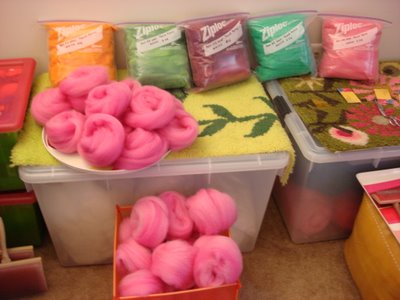
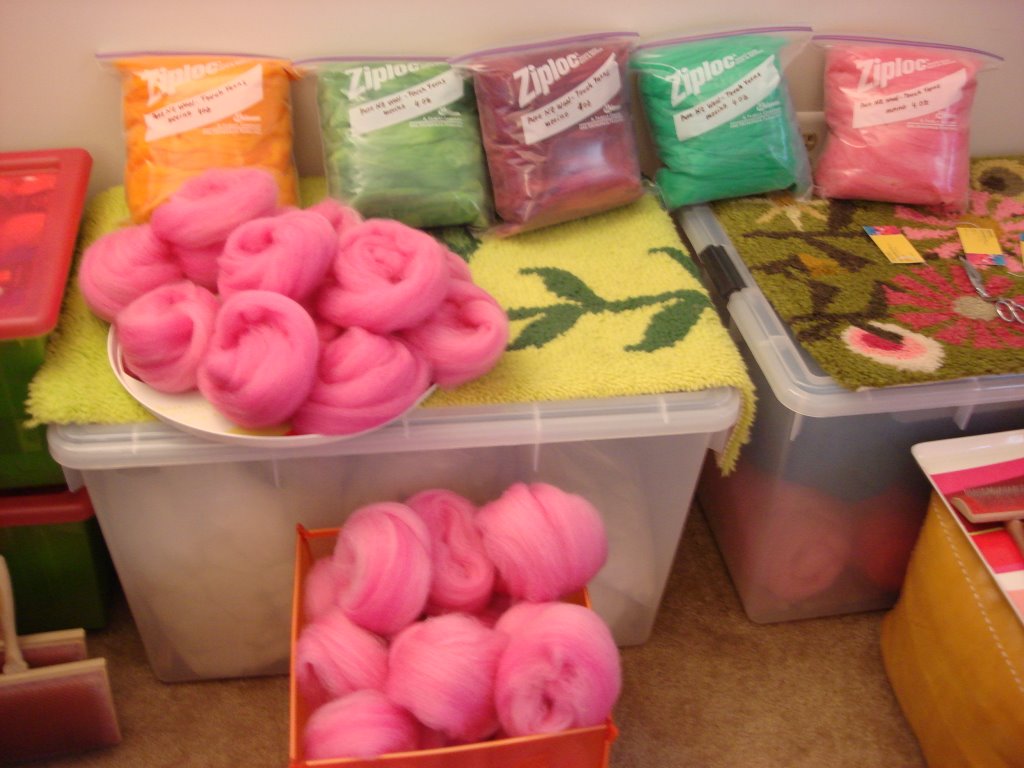
The fibers in Ziploc bags were dyed with Cushing Perfection Acid Dyes. They come in little envelopes priced $3 and weighing 1/3 ounce to color a pound of wool. Nothing else to add other than vinegar. From left: orange, mint green, redgrape, jade green and pink.
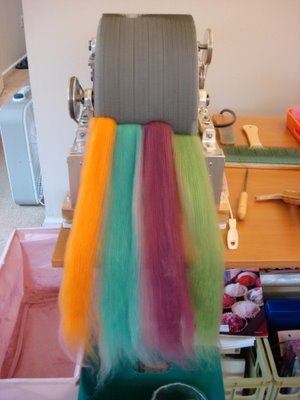
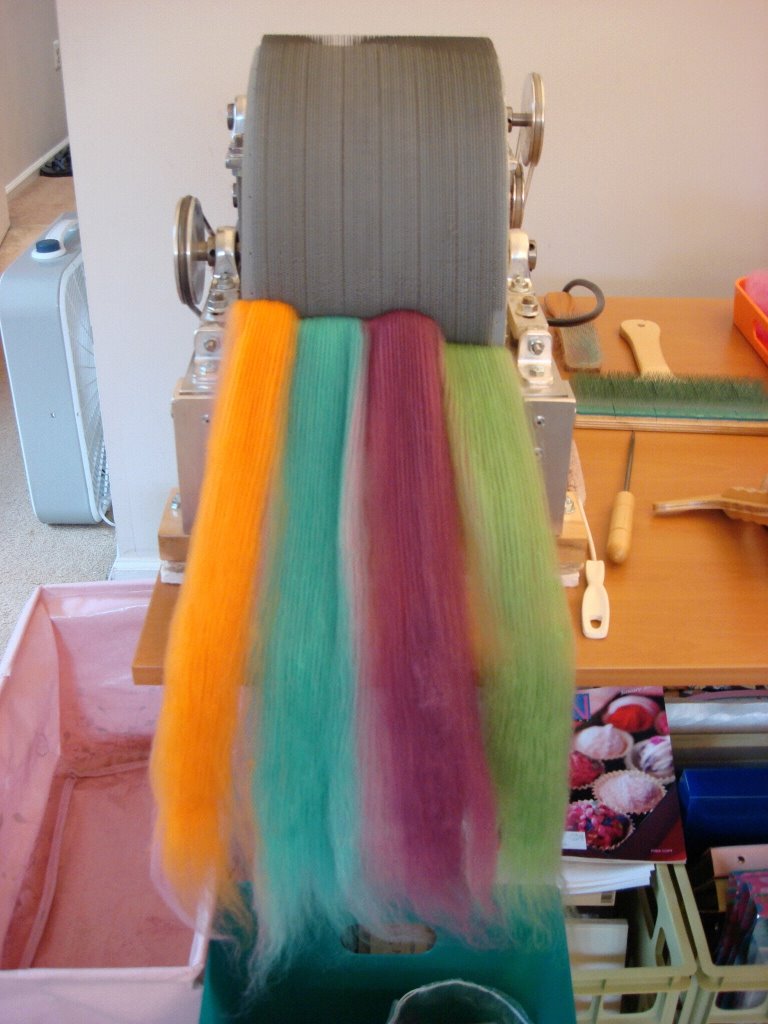
Four of the colored fibers were carded side-by-side and the 5th color, pink, was carded over them.
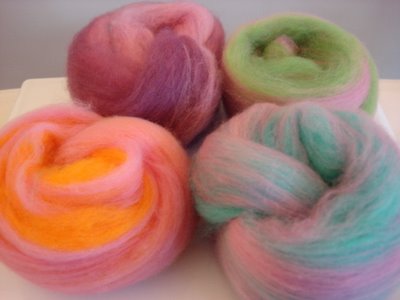
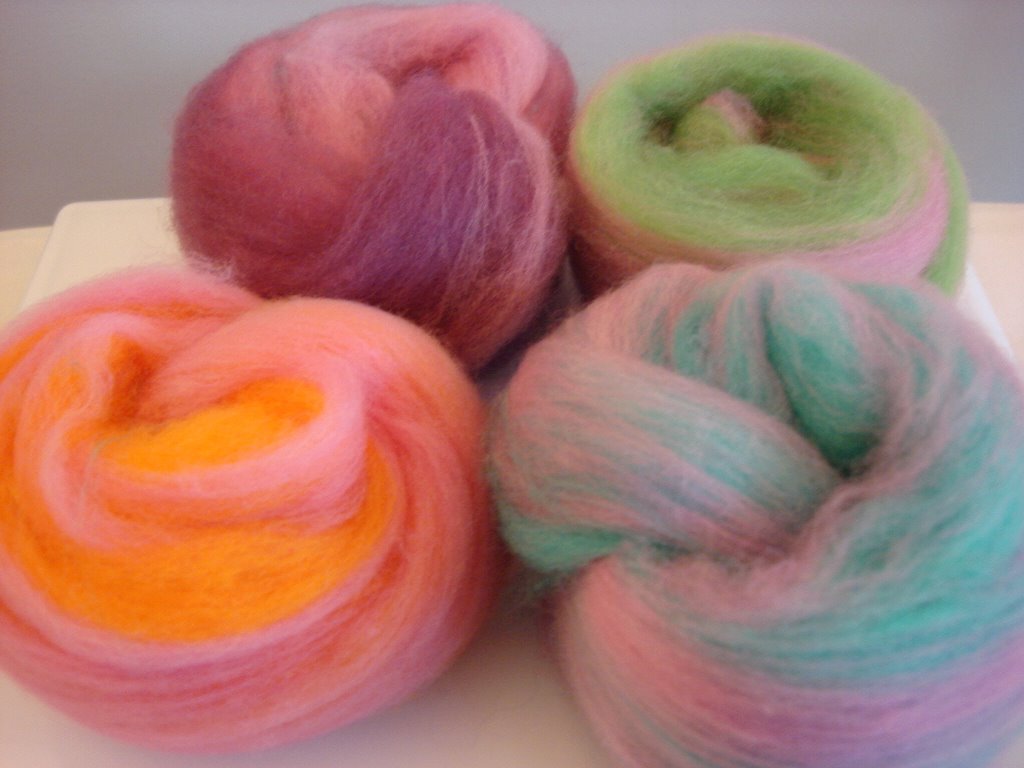
Here are the resulting rovings.
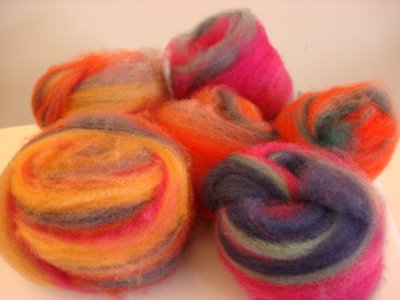
Cushing dyes may be easy to use, but if you want the ultimate dye for dummies, try Gaywool from Australia/Louet. They are used like Kool-Aid: no salt or vinegar necessary. I have even used them without pre-wetting the fiber with success. The colors are electric. There are also the Gaywool Bush Blend dyes which are slightly cheaper, but are so much paler.
Four of the colored fibers were carded side-by-side and the 5th color, pink, was carded over them.
Here are the resulting rovings.
Cushing dyes may be easy to use, but if you want the ultimate dye for dummies, try Gaywool from Australia/Louet. They are used like Kool-Aid: no salt or vinegar necessary. I have even used them without pre-wetting the fiber with success. The colors are electric. There are also the Gaywool Bush Blend dyes which are slightly cheaper, but are so much paler.

Tuesday, January 16, 2007
The Little Gem in a Backpack
I must admit that though I'm a dyed-in-the-wool Majacraft spinner, I have been envious of the Victoria Louet's backpack. Looking around the house for a solution, I remembered a roll-on cabin luggage I bought years ago that converts into a backpack. It's from a store call Muji, which my brother simply calls, 'the no-brand store" because the shop never puts a tag on its products.
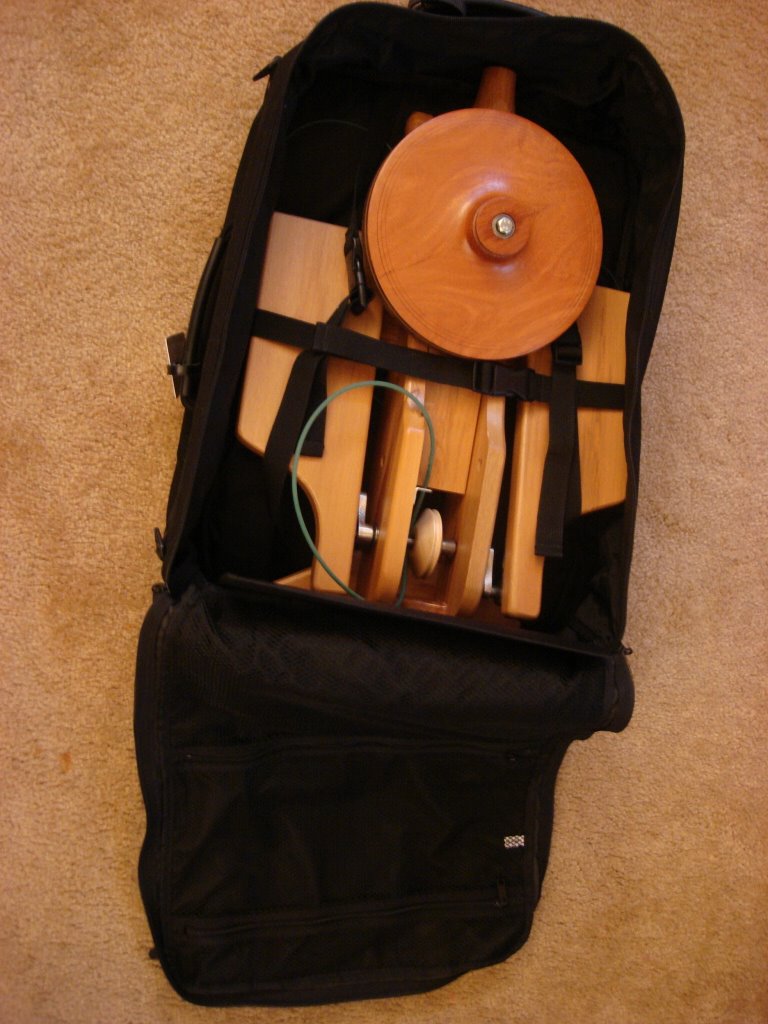
Happily, the folded Gem fits perfectly in the luggage and is held in place by the built-in straps.
To protect the wheel from the detachable metal part, I used a light blanket to wrap the latter.
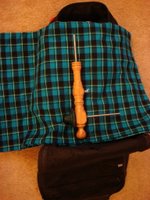
Ben, voilà! C'est parfait!
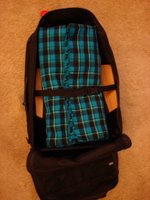
Okay, so the case is not as tight as Victoria's. The point is, I can get the Little Gem on my back just as well!


Happily, the folded Gem fits perfectly in the luggage and is held in place by the built-in straps.
To protect the wheel from the detachable metal part, I used a light blanket to wrap the latter.

Ben, voilà! C'est parfait!
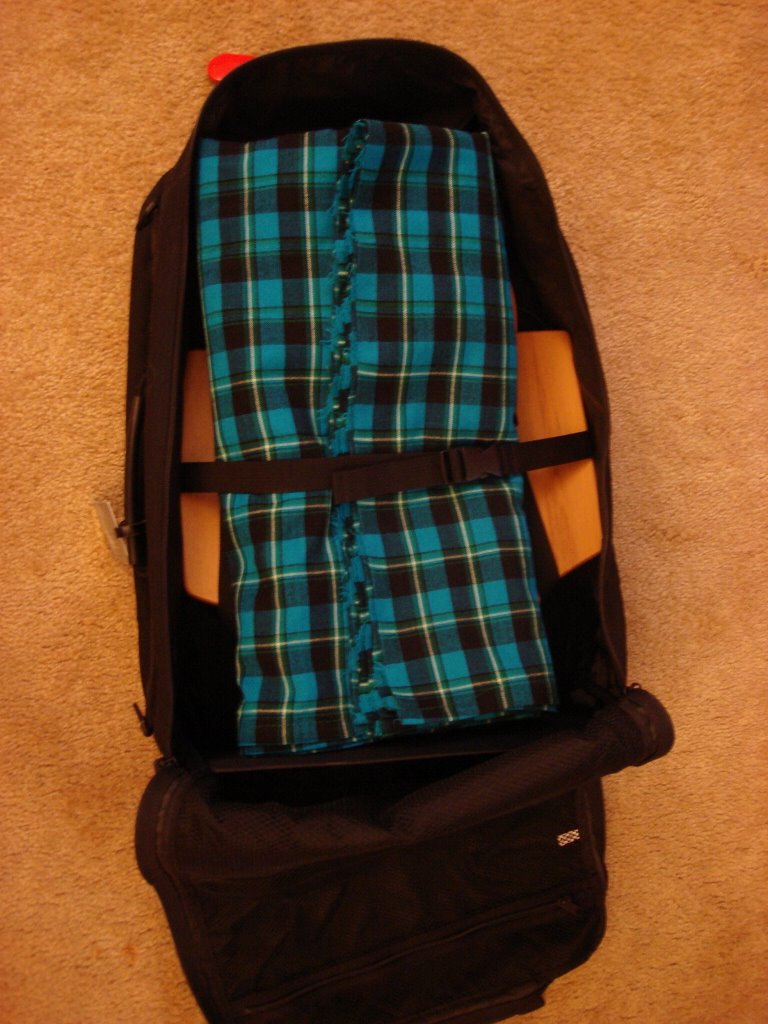
Okay, so the case is not as tight as Victoria's. The point is, I can get the Little Gem on my back just as well!


Monday, January 15, 2007
The Little Gem under Cover
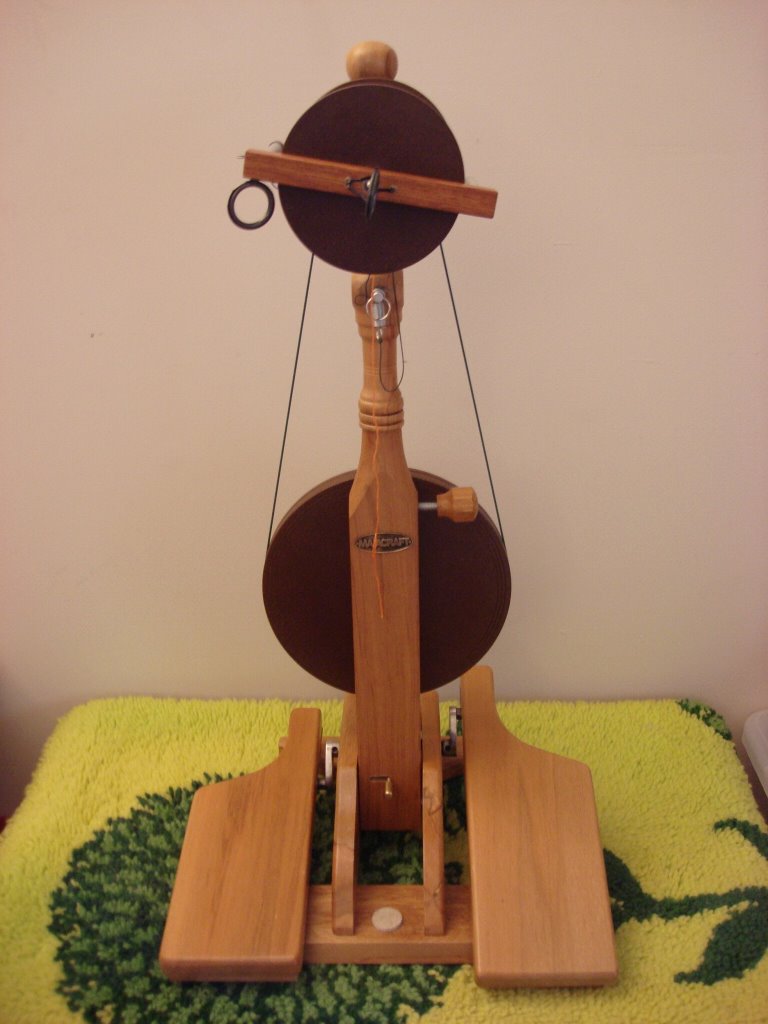
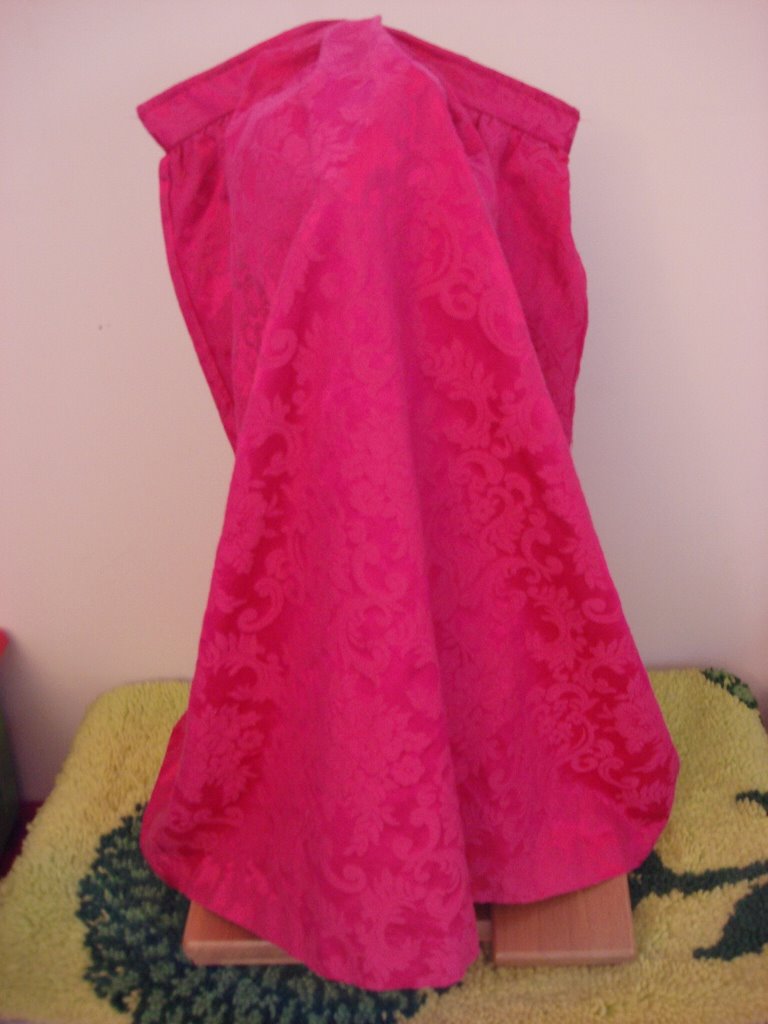
This spinning wheel dustcover was made with a brocade skirt bought at Salvation Army for $3. It's from Talbot's and never worn -- it still had the tag when I found it. I simply sewed it along the waist like so:

Sunday, January 07, 2007
Springwater Fiber Arts School
I count myself lucky to have a fiber community in my area, the Springwater Fiber Arts School. I live in Maryland, but Springwater in Alexandria, Virginia, is only about 15 miles away and the route, all of which is along the picturesque George Washington Memorial Parkway, is a beautiful drive.
Springwater is supported by grants, donations, a well-stocked yarn-and-fiber store and, of course, the school. Donations are sold at the store or used in its outreach program. Recently, it found itself with massive bags of scoured fiber donations. Springwater's Sylvia Delmar and Linda Hurt, who teach spinning and weaving, respectively, recently set about to further prepare the fibers by picking and carding, and dyeing them before putting them out for sale.
In the photos are Linda, working on her Pat Green Triple Picker, and behind her, Sylvia, carding away.
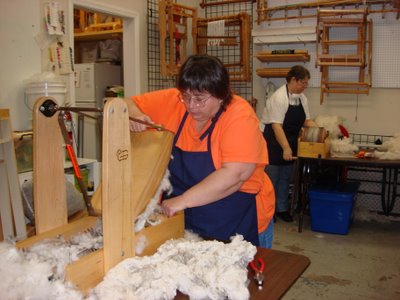
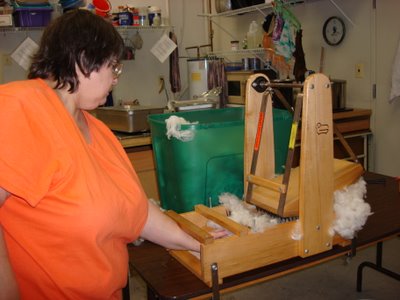 Linda shows how to feed wool into the Triple Picker safely. There are 600 long, sharp nails waiting to claw at you if you're not careful.
If you live in the DC-Maryland-Virginia area and have fiber supplies, tools and equipment sitting idle at home, consider donating them to Springwater to support the school, and avail of tax deductions. The Springwater Super Bowl Sale is coming up on February 4. This is when designated items are sold at 60% off when the shop opens at 7 am. At 8 am, the discount go down to 50%, then at 9 am and the rest of the day, shoppers get 40% off.
If you are thinking of getting spinning and/or weaving equipment, this is a good time try your luck at bargains. Loyal shoppers are known to camp outside the store as early as 5 am with their mugs of coffee.
Springwater is supported by grants, donations, a well-stocked yarn-and-fiber store and, of course, the school. Donations are sold at the store or used in its outreach program. Recently, it found itself with massive bags of scoured fiber donations. Springwater's Sylvia Delmar and Linda Hurt, who teach spinning and weaving, respectively, recently set about to further prepare the fibers by picking and carding, and dyeing them before putting them out for sale.
In the photos are Linda, working on her Pat Green Triple Picker, and behind her, Sylvia, carding away.
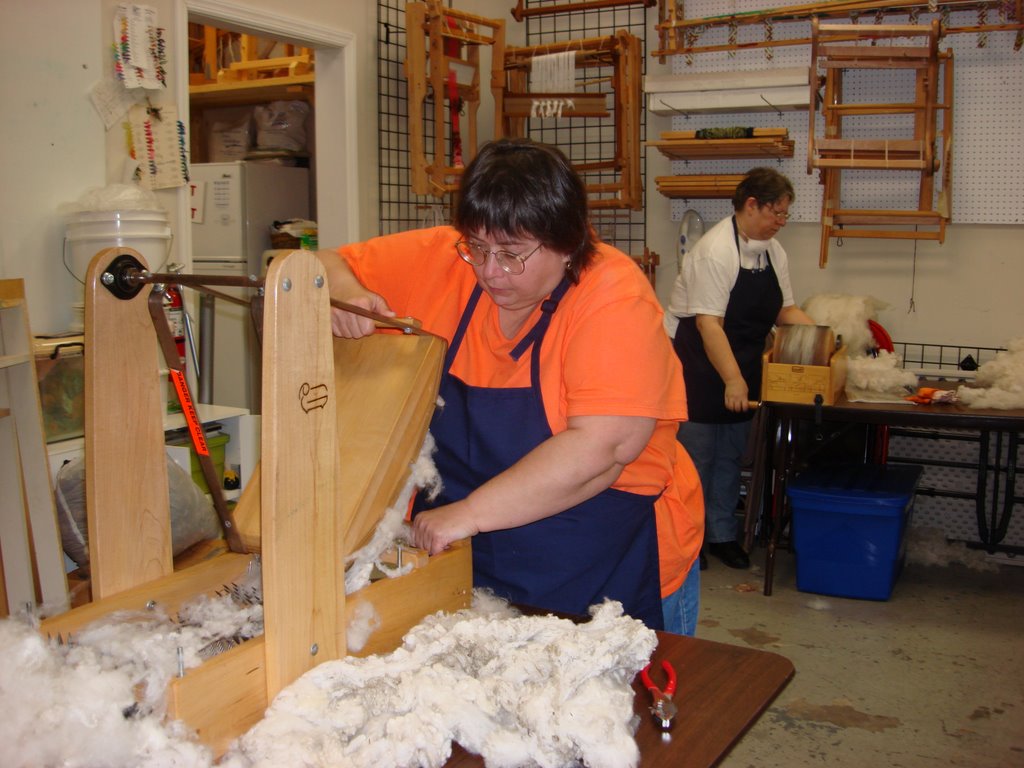
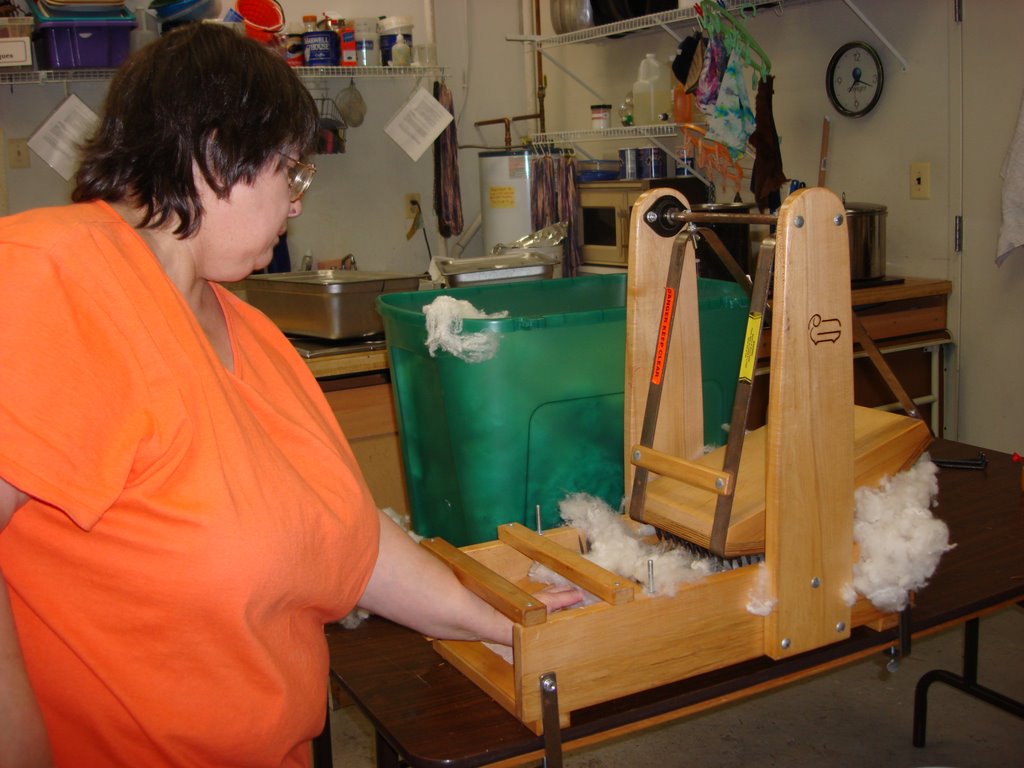 Linda shows how to feed wool into the Triple Picker safely. There are 600 long, sharp nails waiting to claw at you if you're not careful.
If you live in the DC-Maryland-Virginia area and have fiber supplies, tools and equipment sitting idle at home, consider donating them to Springwater to support the school, and avail of tax deductions. The Springwater Super Bowl Sale is coming up on February 4. This is when designated items are sold at 60% off when the shop opens at 7 am. At 8 am, the discount go down to 50%, then at 9 am and the rest of the day, shoppers get 40% off.
If you are thinking of getting spinning and/or weaving equipment, this is a good time try your luck at bargains. Loyal shoppers are known to camp outside the store as early as 5 am with their mugs of coffee.
Thursday, December 21, 2006
More Color: knitting with one's short handspuns
This is what you get when you knit a big project with your handspuns, which are often under 100 yards.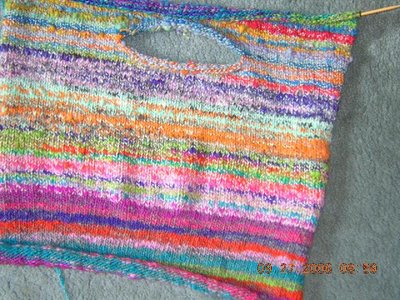 I didn't want to be limited to hats and mitts, so I attempted to knit a sweater with a dozen small skeins, inspired by this photo below.
 The knitted up fabric looked great. However, because I used US size 8 needles, the result was too stiff to be comfy as a sweater. In fact, it was more suitable for a placemat. The project is now frogged and I've swatched with a US size 11 and it's now just fine!
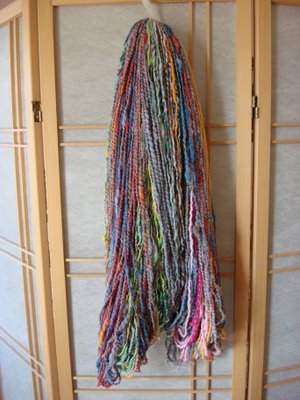
The dozen or so yarns linked together to create a huge hank.
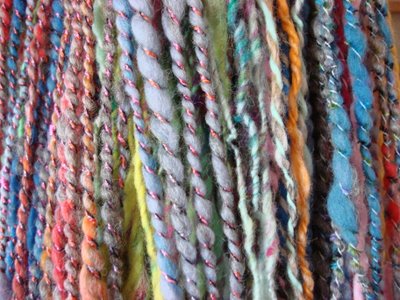
The yarns up close.
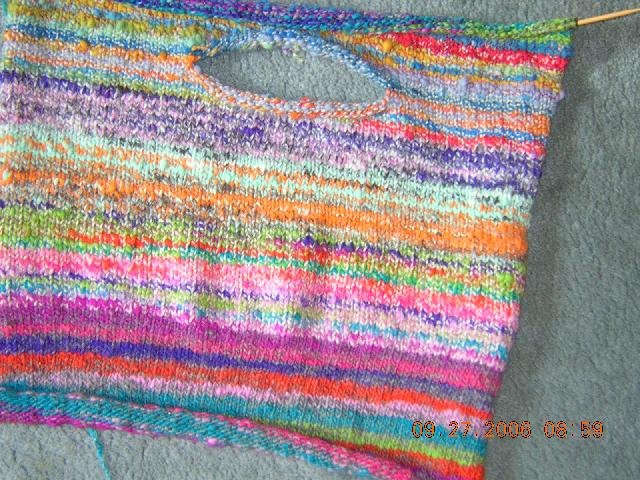 I didn't want to be limited to hats and mitts, so I attempted to knit a sweater with a dozen small skeins, inspired by this photo below.The knitted up fabric looked great. However, because I used US size 8 needles, the result was too stiff to be comfy as a sweater. In fact, it was more suitable for a placemat. The project is now frogged and I've swatched with a US size 11 and it's now just fine!
The dozen or so yarns linked together to create a huge hank.

The yarns up close.

Subscribe to:
Posts (Atom)