Friday, May 26, 2006

Introducing the charkha to the women of Ethiopia

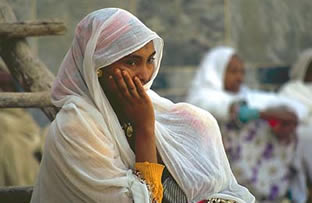
This is the traditional Ethiopian garb. It is made of cheesecloth woven by hand with cotton thread spun on a spindle.


Here is an Ethiopian woman spinning cotton fiber on a spindle. It is nothing more than a barbecue stick, a whorl made of heavy cardboard and a staple wire bent for parking the just-spun thread.


And when she needs to park the spindle to fluff her fiber, she does so on her ear. A charming process. That is, until you think about the realities of life in Africa: Needing to spin to survive.

In the last five years, I have had the privilege of traveling to Africa on the business of battling AIDS. I have met grassroots folks who have had to support community AIDS projects with income-generating activities, such as selling their own handicrafts.

As an aspiring spinner then, I had also struggled to produce spun yarn, with a spindle, that was long enough to make a knitted swatch. In time, I just bit the bullet and bought my first spinning wheel. And, boy, did it gallop, compared to the spindle!

Then I produced my first full bobbin and niddy-noddied it to a skein. Then there were 50 skeins consecrated to the Brooklyn Renegade Craft Fair booth of Handspun Collective, a consortium of "spinners with attitude" that I belong to. Then Jacey Boggs, Insubordiknit herself, emailed an invite, "Can you produce 300 skeins for Stitches East between May and October?!" Hmm, that is a lot, but with a wheel, it's do-able.

So, I knew that if I could only get spinning wheels to an African country with a strong handspinning tradition, it could make a difference. Or, at least, I could try.

My first stop was New Zealand, land of wool and second home to me and my husband. I knocked at the doors of Ashford and Majacraft. Ashford offered a substantial discount on their spinning wheels and no break on shipping. Majacraft offered two old spinning wheels -- not their brand -- that had gathered dust in its factory shed that was going to be abandoned for a new one. Glynis Poad, the owner and the spinning lady in all the Majacraft ads, also volunteered to pick up the shipping tab. I took up her kind offer.

Once the vintage wheels arrived at my doorstep in Maryland, I realized that bringing them to Africa was not the way to go. First, even in their dismantled state, they were bulky, not to mention, heavy. They would be expensive to dispatch, whether as parcel or as checked-in luggage. Second, they were not simple enough to duplicate, if the end-users so desired. Third, the standard spinning wheels are more for wool than cotton, which is the fiber of choice in the continent, although they raise sheep for wool in some parts of Africa. So, I sold the wheels to aspiring spinners at my fiber workshop, the Springwater in Alexandria, Virginia. I turned around and registered myself with Nels Wiberg's Babe's Garden Fiber as a retailer of PVC pipe charkhas, the ideal equipment for spinning cotton. Weighing 2 lbs., 11 oz., getting them to their destination would be no trouble at all.

And that is how I was able to bring four charkhas to Addis Ababa this month.

"PVC?" the Mary Joy project manager of the kebele (locality) I went to said, "sure, we have those; we use them as water pipes."
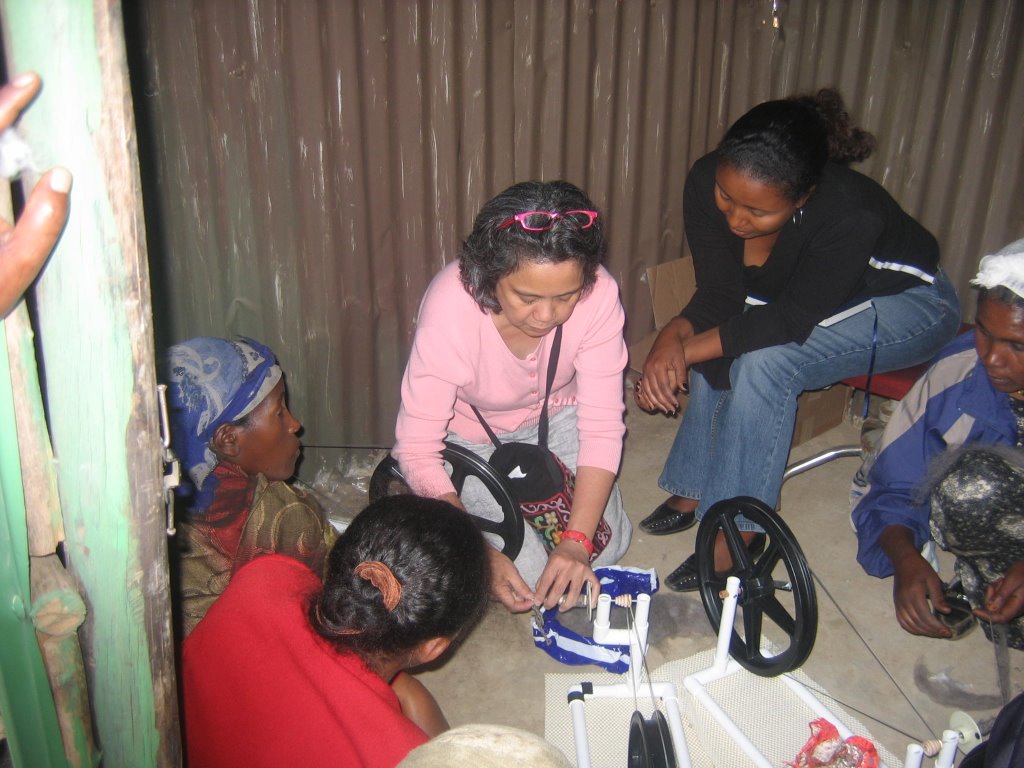
Here I am assembling a charkha with a Mary Joy staffer who acted as interpreter.


As anybody anywhere in the world with a new "toy", the Ethiopian women were enthralled.
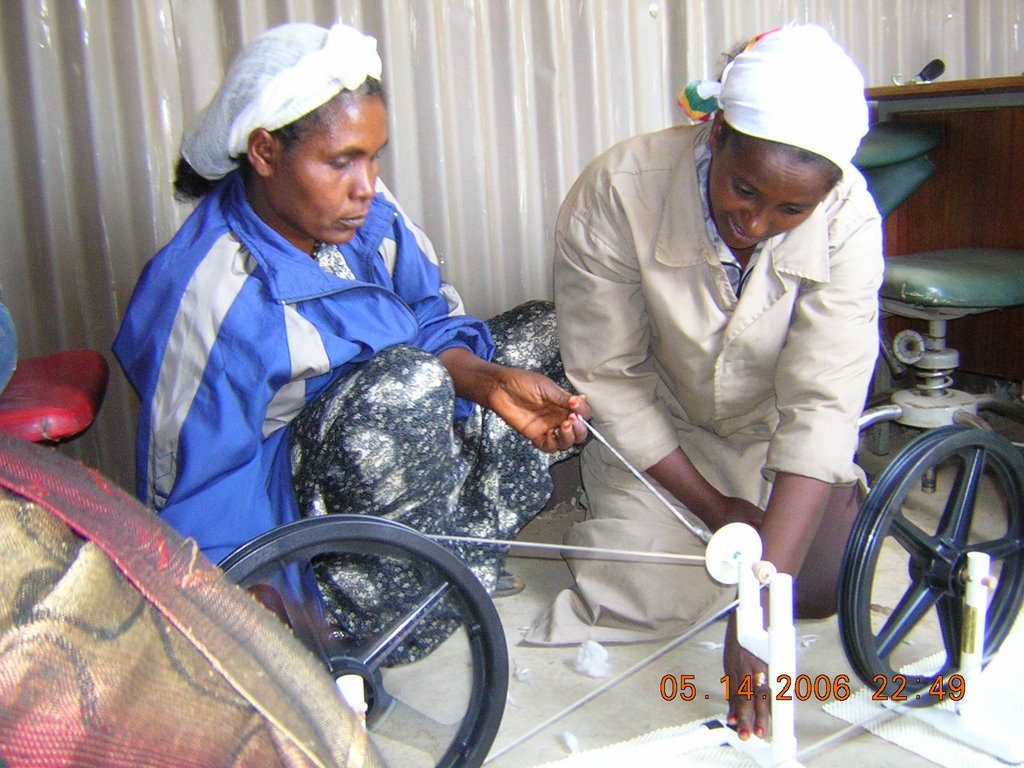
In the meantime, I have met other Africans who would like to see the same equipment introduced to other countries in the continent. Togo, for instance. And Mali, where they are, I was told, also badly in need of handcarders.

If you would like to help by donating an idle spinning wheel or a set of handcarders, please email me.

Alternatively, a cigar box charkha can be built with Spin-Off magazine instructions at this site. Also, I'd be happy to receive spare dog rakes and combs as handcarder substitute. Email me for the address. Thank you, Ava and Cheri, for the great ideas.

Wednesday, May 24, 2006

Laurence Pocztar: Meeting the wool fairy behind lainezinzin

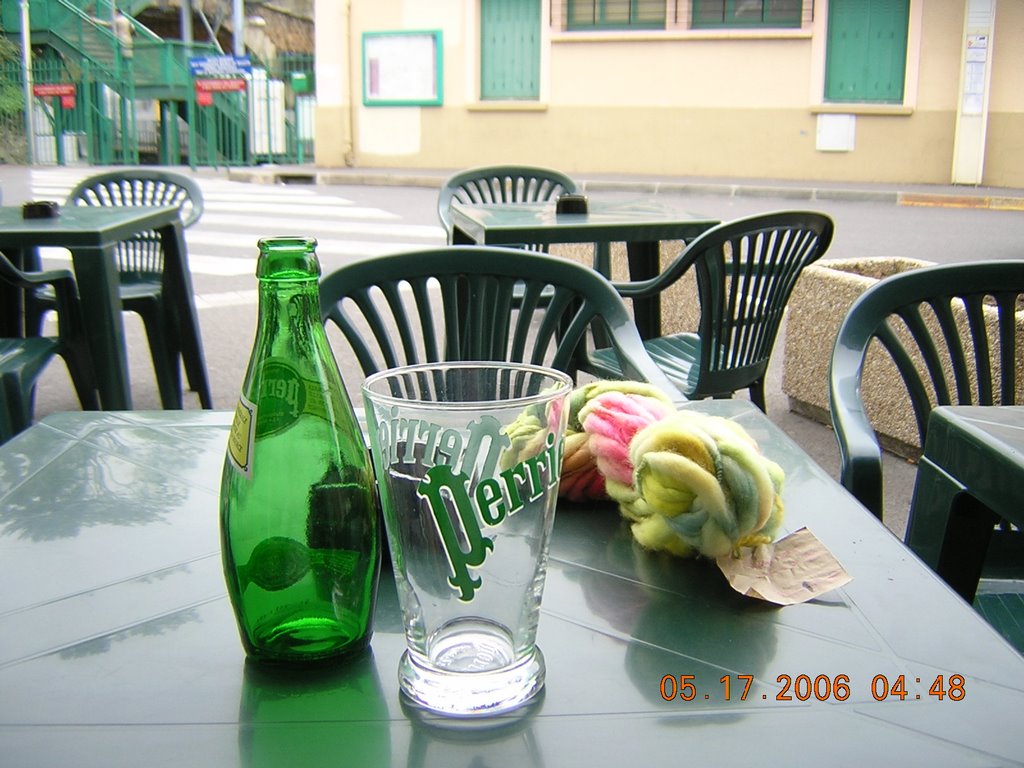
Here I am outdoors of the tabac in front of the Palaiseau RER station. This is Laurence Pocztar's train stop. Palaiseau is just outside Paris, about 20 short stops from the Etoile. I'm bringing a bag of fiber-related goodies and I put a skein of handspun on the table so she doesn't miss me.

In front of me are some of the people in the neighborhood, having beer and saying "hello" to each other.

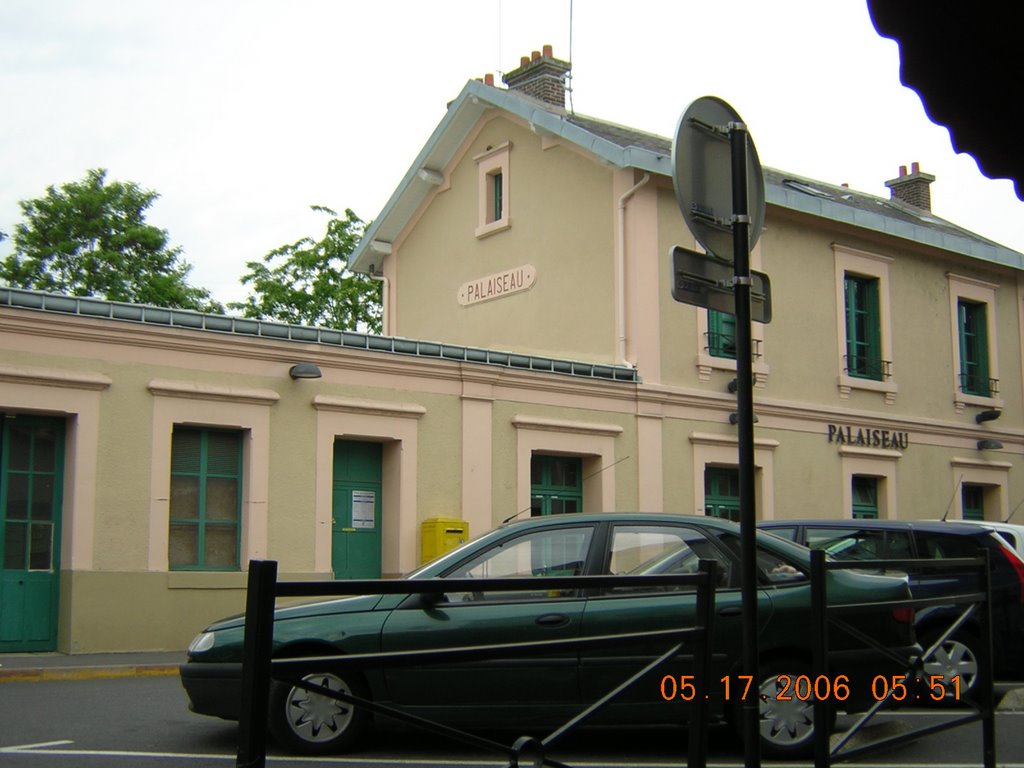
From the tabac, you look up and see the train station building.

Finally, Laurence picks me up in her little yellow SUV and, at home, I meet her 18-year-old son, Adrien, and her 12-year-old daughter, Garance (seen here taking our photo). She is unpretentious and unaffected. Genuinely warm at first meeting, although we had hardly said much in emails, other than to agree on the time and the date.

We have tea in her living room and then we go to her garage-turned-studio filled with bags of fleece and all the accoutrements of a fiber artist: spinning wheel, weaving loom, knitting machine, washing machine, pressure cooker, dye powders from France, as well as from Madagascar (her father worked for the UNESCO in Paris as my dad did in the '80s).

We are to have pizza, but we chat and chat in her studio. Laurence spins on my Little Gem which I carried onboard the plane from the US to East Africa and back to Europe. Before we know it, the sun is coming down, it's getting close to 10 pm and I'm horrified to miss the train. Poor Adrien and Garance, it must have been an eternity waiting for the pizza that had yet to be ordered.

Laurence walks me to the train station. It is 30 minutes before the train is to arrive and she is so sweet to sit and wait with me. We talk about public education (she teaches plastic arts) and the growing racial tension in America and in France. The train comes and we hug and she says, "Desormais, nous sommes amies." (From now on, we are friends.)

I ride back to Champs Elyees, close to my hotel and I stop at the breadshop chain, Paul, to pick up a wedge of quiche lorraine and strawberry tart. Then I go back to my hotel, Claridge Bellman, and take this photo on the prepared bed for the benefit of my spinning friends who are great lainezinzin fans.


POSTSCRIPT: I wake up the following morning and see my loot courtesy of Laurence. It puts a smile on my face and then the smile disappears. SHIT! I forgot to take pictures of the wool fairy in her studio.

Sunday, April 23, 2006

Brooklyn, here we come!


After applying as a Renegade vendor in Brooklyn and waiting for months, Handspun Collective is finally in! Carrie Wood did all the hard work.

Friday, March 17, 2006

Ready for the Bigtime!

Thursday, February 23, 2006

Michelle Aplin's Finnsheep Flock


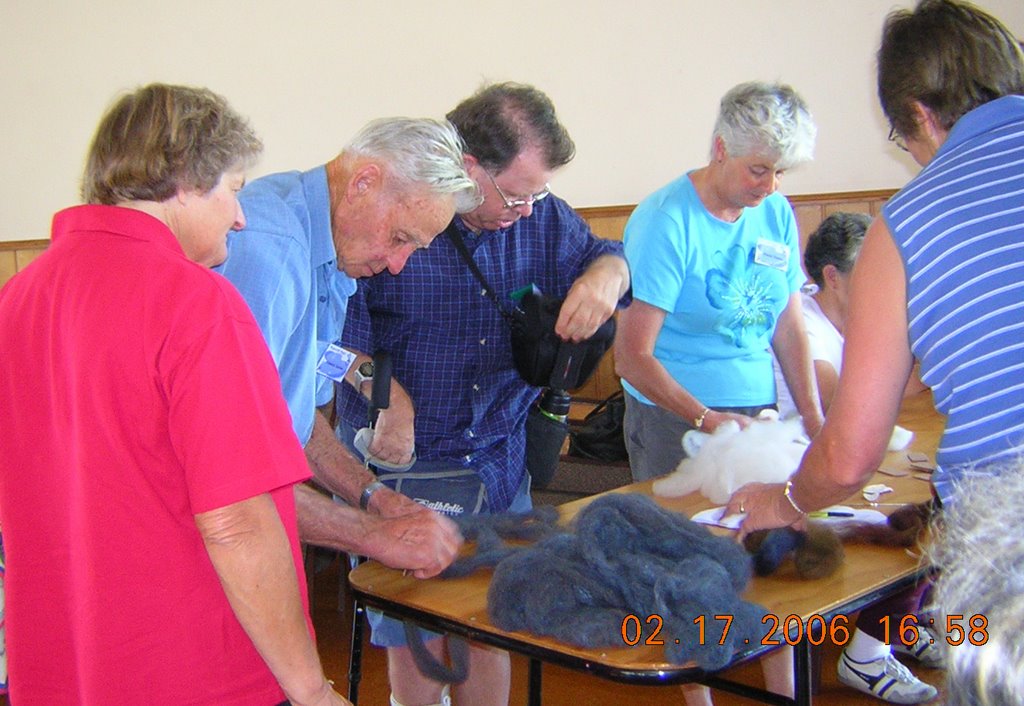
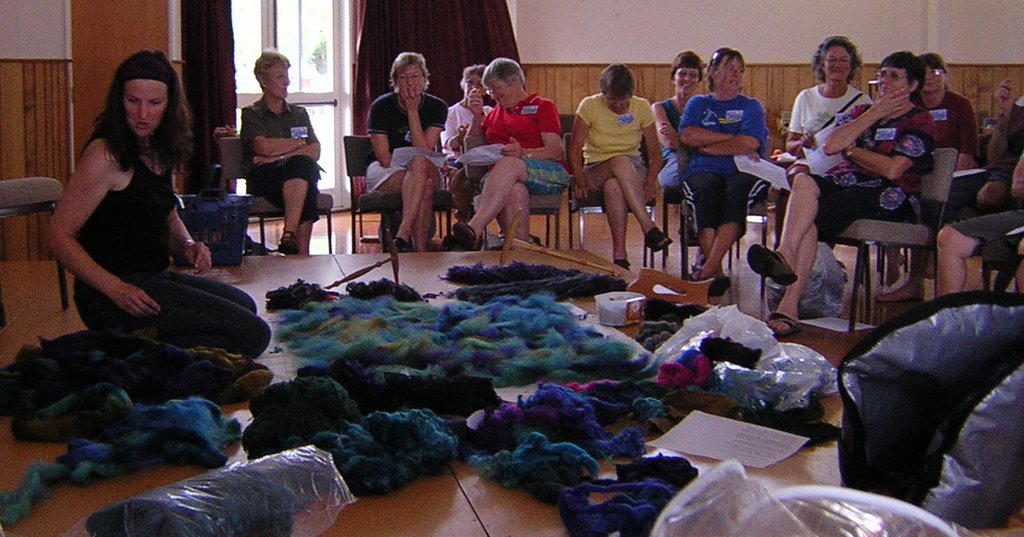
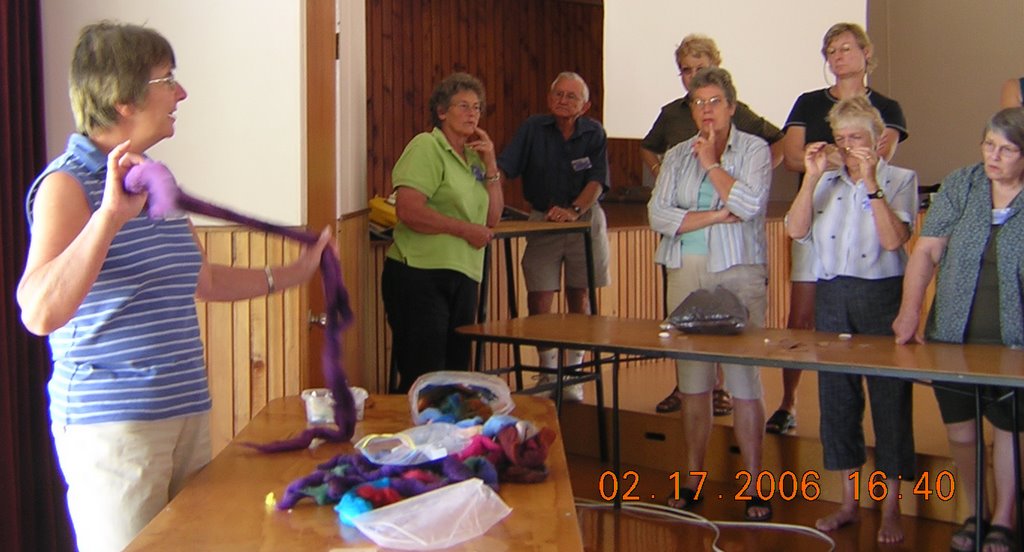
That's Michelle Aplin in the middle telling spinners all about her Finnsheep flock that has grown from 19 to 90. Finnish Landrace first arrived in New Zealand in the 1980s and was released from quarantine in 1990. It has a fine wool of high luster.

Too bad I met Michelle on the third week of my trip and had already accumulated a large duffel bag of wool. Still, I managed to squeeze in three kilos of her luscious fiber (white, black and a two-toned gray), thanks to Pat Old who packed Patsy Zawistoski's wool when the latter was visiting New Zealand. Pat's advice: put the fiber in a strong plastic bag, use a vacuum cleaner to suck out all the air, tie the end tightly, fold it over and tie again. It worked! I brought back to the US 25 kilos of wool. That's more than 50 lbs packed in a duffel bag and a half.

Below, more fibery goodness.

Wednesday, February 22, 2006

Meet More Poads: Robert and Andrew

...Majacraft production manager and marketing wiz, respectively.

Robert trying his hand at spinning a cocoon,...

...spinning green merino to make Kermit for his daughter, Hope,...

...lovingly tuning up a Suzie.

Andrew curiously studying the cocoon his brother is spinning, and...

below, helping a spinner with her wheel's flyer.

Tuesday, February 21, 2006

Meet Glynis and Owen Poad

They are just about my favorite Kiwis.

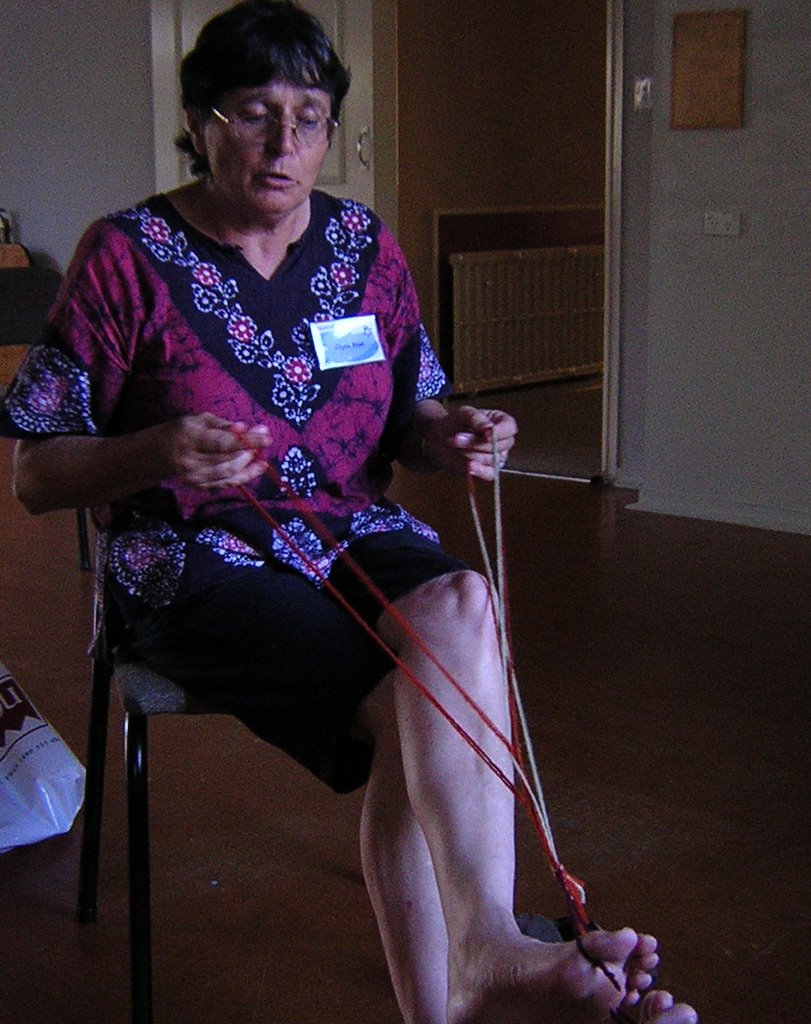
Glynis taught us how to do traditional braiding with no gadgets; just the toe. She's the one who answers emails to Majacraft and appears in all the ads.

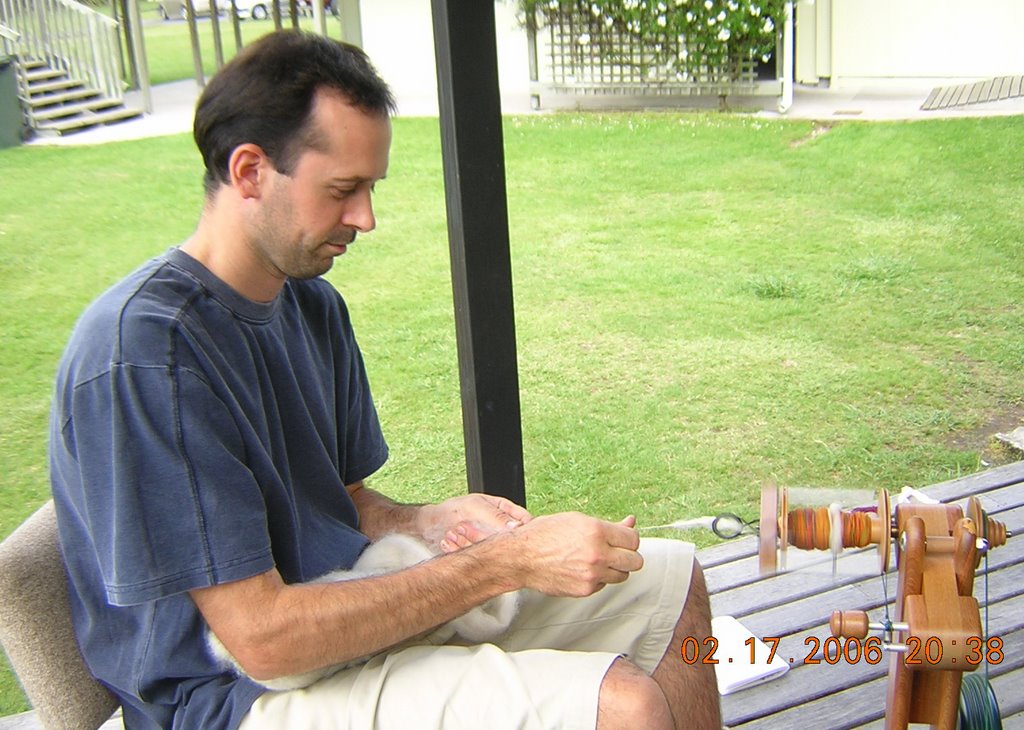
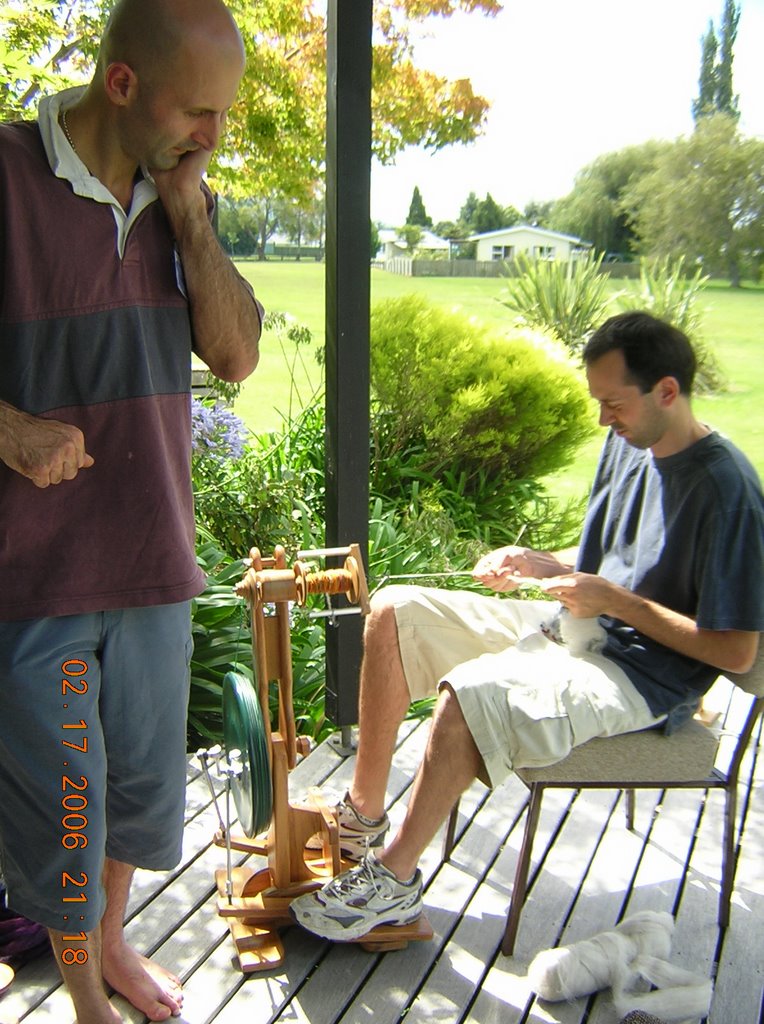
Owen created the Little Gem, modifying it over a period of three years. Now it's perfect! Here he is spinning on my own Little Gem (how cool is that?!). Notice under the chair Glynis' copy of Lexi Boeger's Handspun Revolution. The Poads rock!

Monday, February 20, 2006

What I loved about Majacraft Magic...

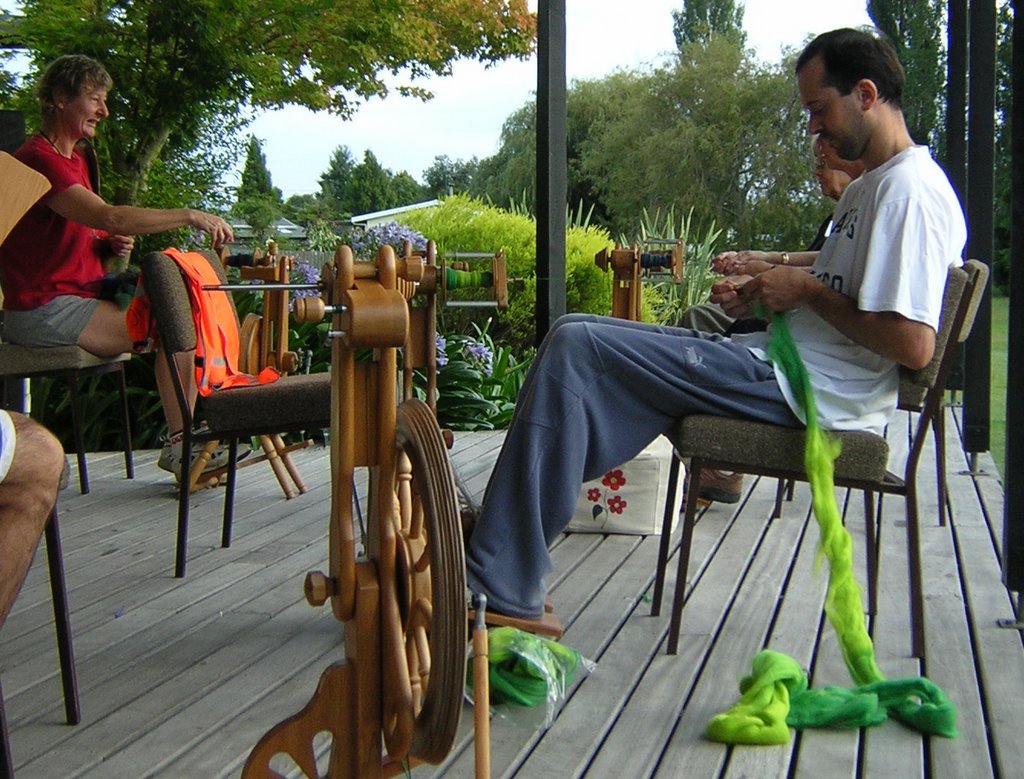
...the men spun so unabashedly.

This gentleman came to the retreat with his wife.

The Majacraft Men: from left, Andrew, Owen and Robert Poad.

Learning to diz from Pat Old.

Aren't they cute? The couple that dizes together, stays together.

Sunday, February 19, 2006

More photos from Majacraft retreat in NZ's North Island

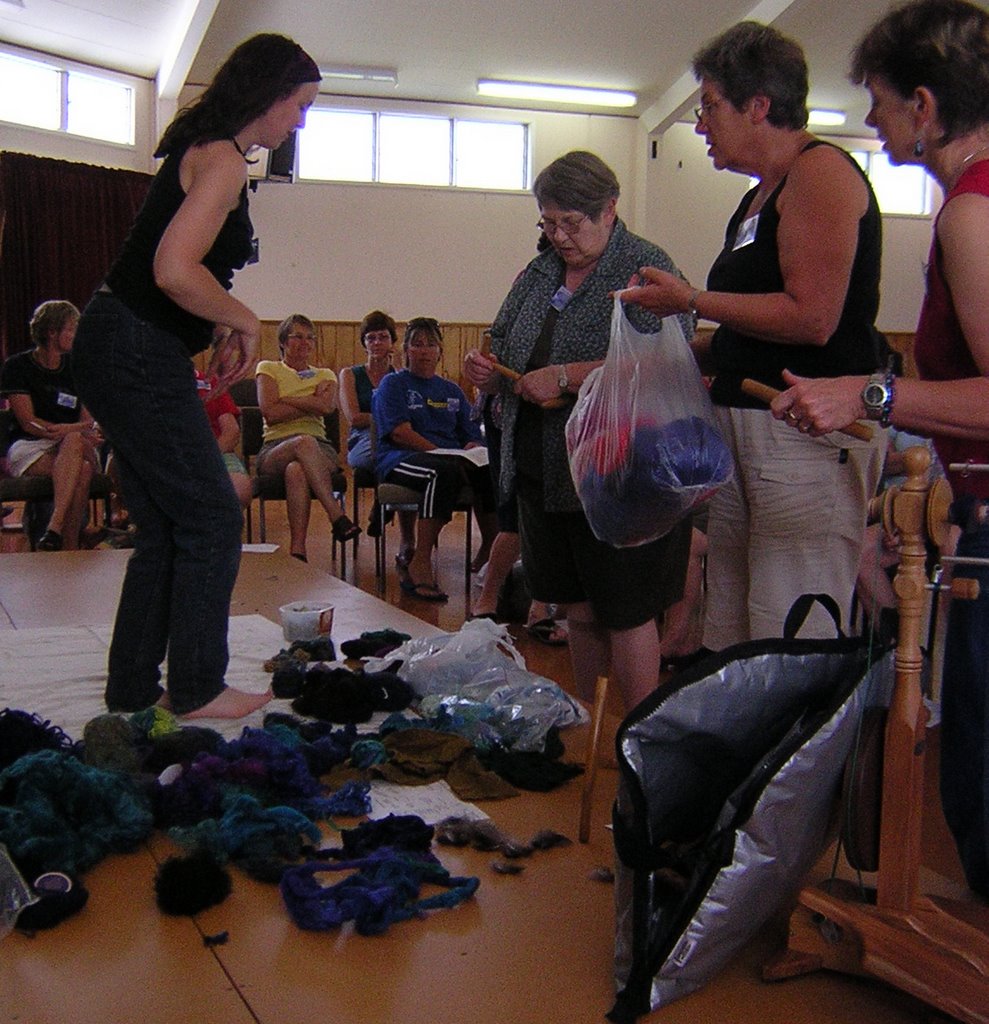
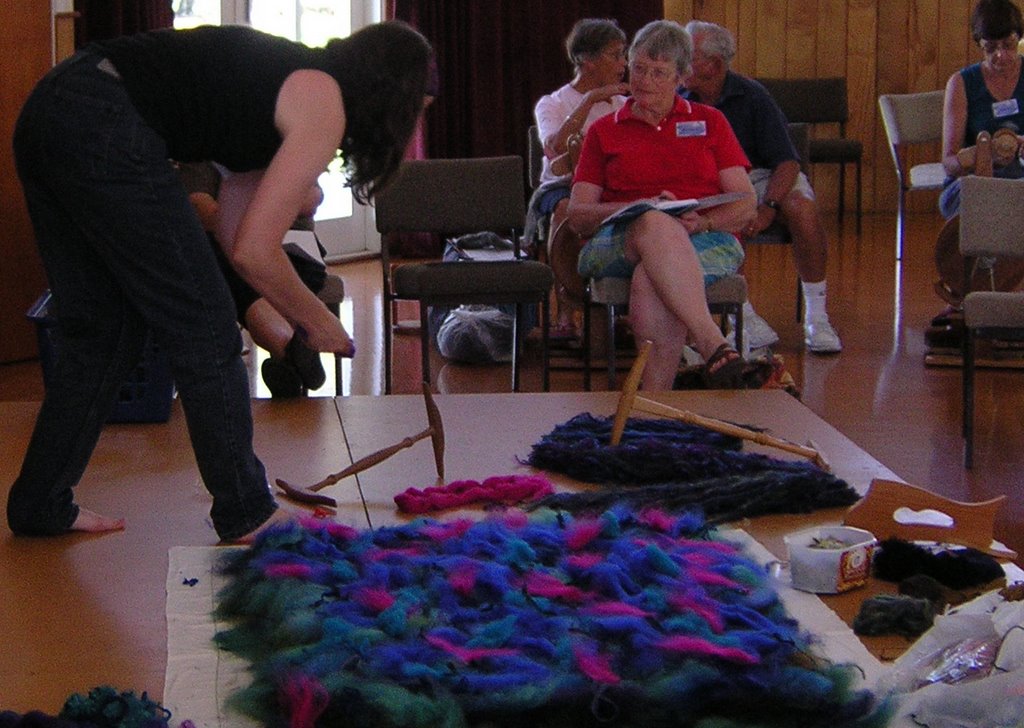
Tracy White introduced her brand of blended fibers which she calls "fiber sandwich".

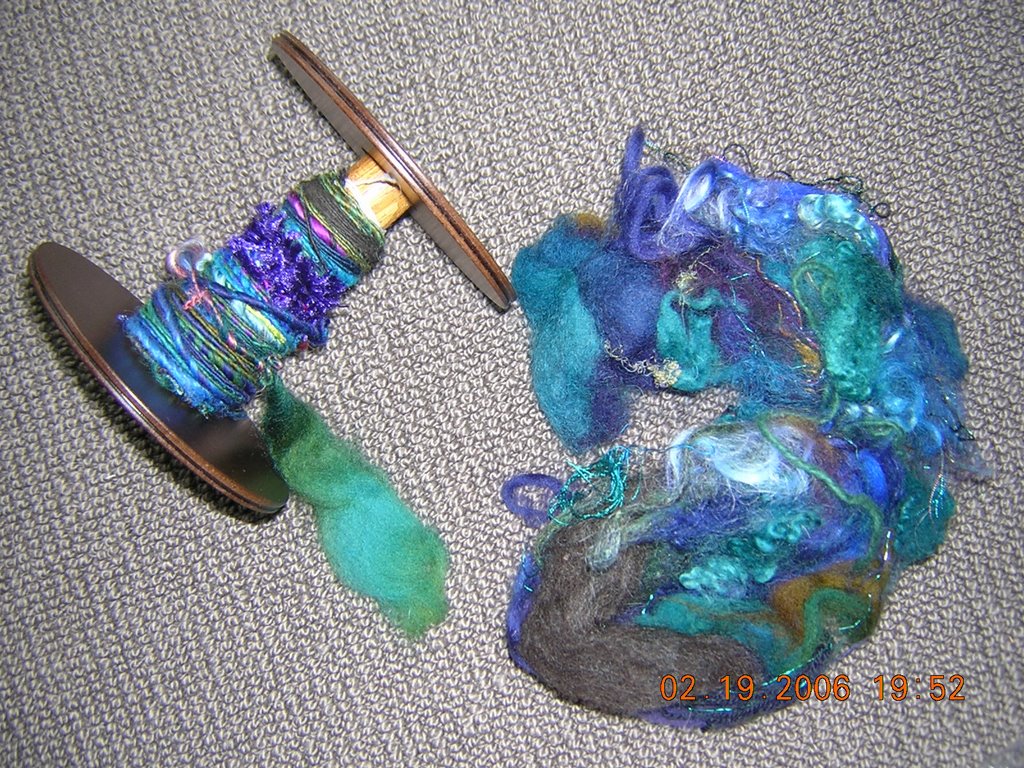
This is my skein spun from the fiber sandwich. Photos below show how the fiber sandwich was created.


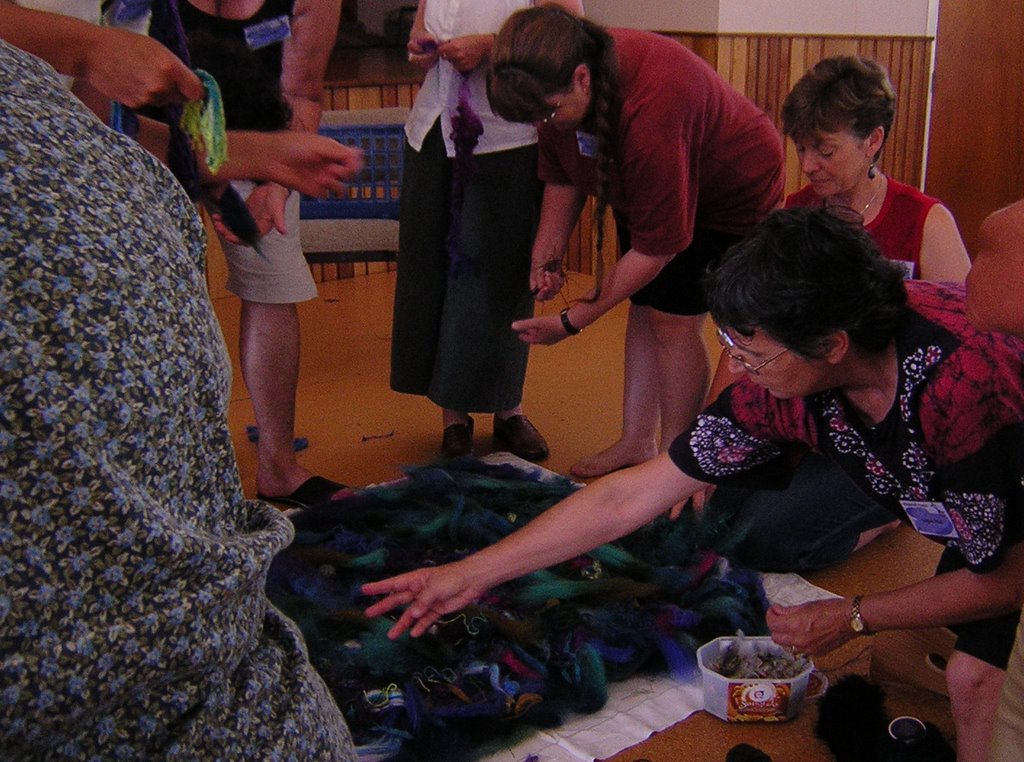
Tracy shows how to spin and connect fiber, commercial yarn, and strips of fabric.


My piece of the sandwich, up close and half-spun.

Saturday, February 18, 2006

Majacraft Magic Weekend of Spinning

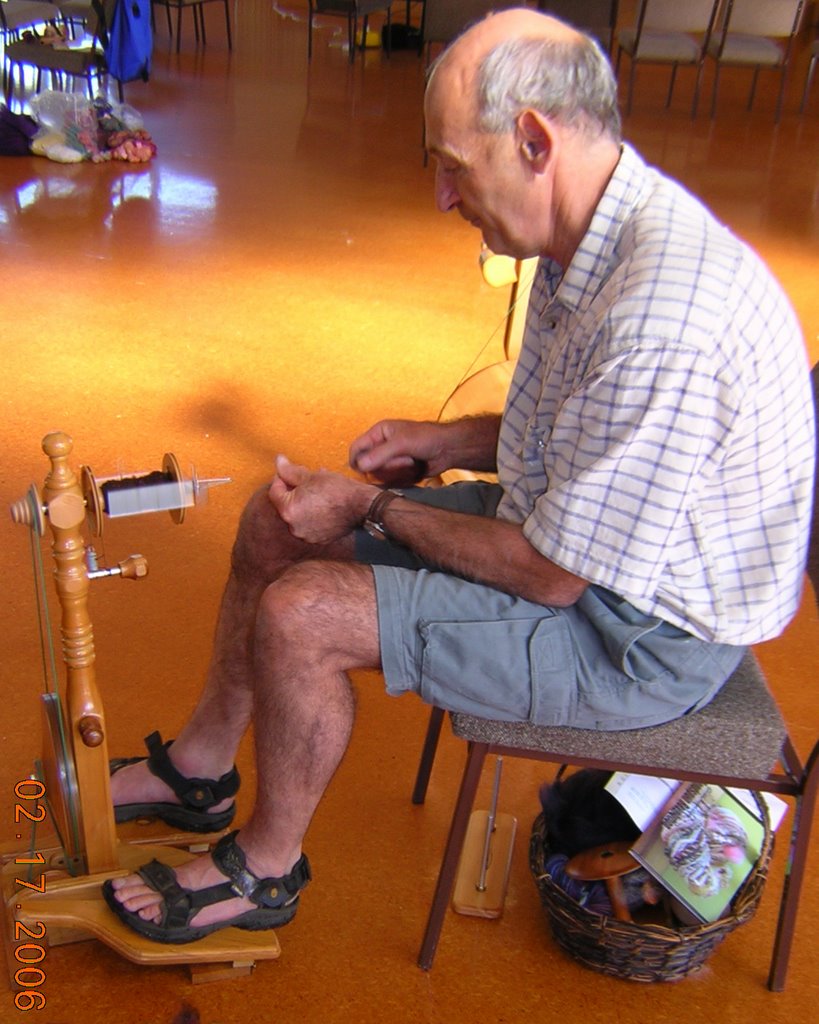
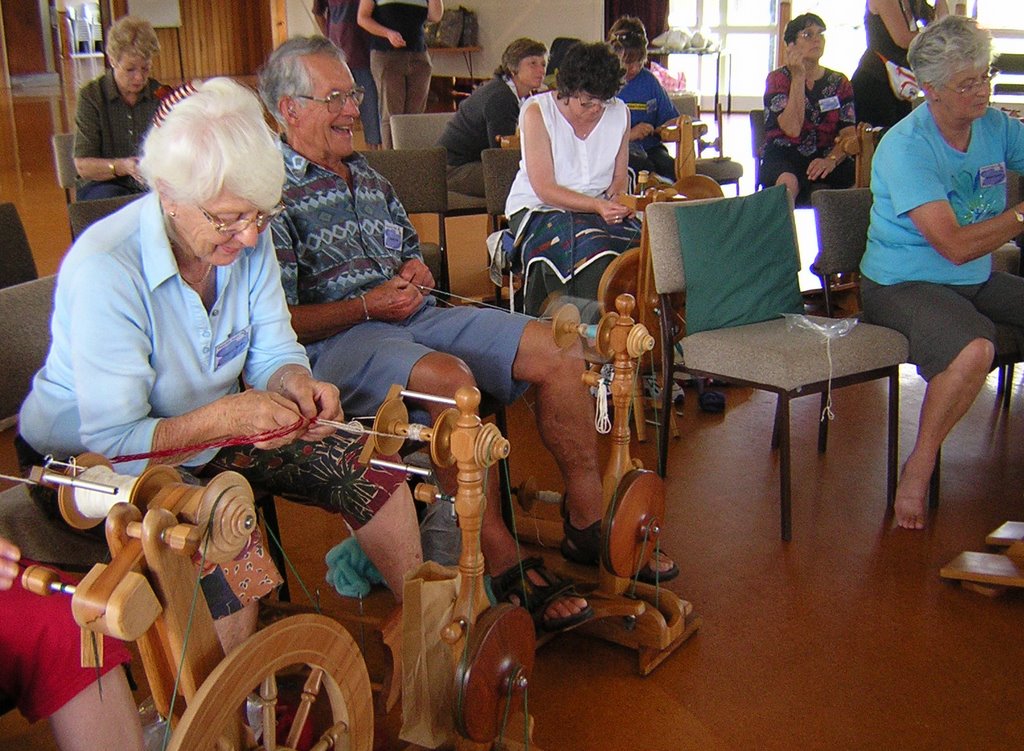
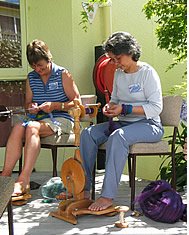
Pat Old (left), well-known Kiwi fiber artist, and me spinning away on Little Gems. Read about it here.

Pat, teaching spinners how to use the diz. She also taught us a trick on how to make instant bouclé: spin a single from regular wool and another from superwash, then ply them together and felt. Voîlà, instant bouclé.

I tried to passed on to Pat what I learned from Lexi Boeger at Camp Pluckyfluff East, like the cocoon and the nubbs. In the photo is her first attempt at the cocoons, following my miserable instructions. Of course, Pat made better cocoons on her own! By the way, Pat has the Certificate of Excellence in Handspinning.

Mental note: Send for that HGA package. : )

Tuesday, February 14, 2006

Updated: Mary had a little lamb...


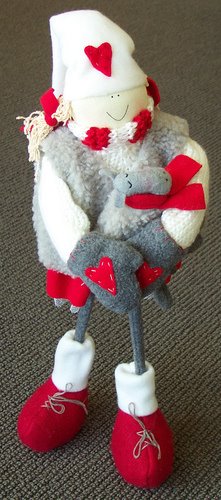
Happy Valentine's Day! Another fun creature from In the Pink, this one a girl hugging a grey sheep with rosy cheeks.

The day was spent in Dunedin and driving back to Queenstown. Along the way, in Roxburgh, we found Tally-Ho Natural Coloured Wools run by Don and Janet Peel. They raise romney, moorit and gotland and Don dyes the fleece, which he does so evenly on the wool.

Thursday, February 09, 2006

Cool Sheep

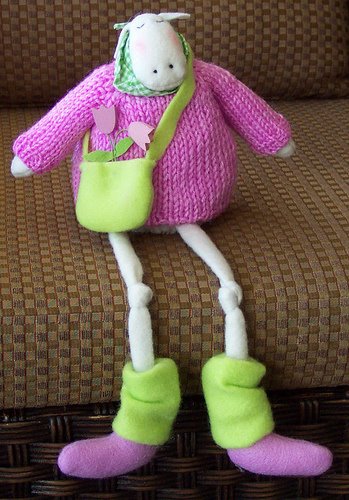
Here's a cool sheep all decked in pink and green. She's from a Kiwi shop called In the Pink and I was told she comes from France.

Saturday, February 04, 2006

Creative Queenstown Arts and Crafts Markets

Saturday in Queenstown means arts and crafts market on the lake front. There are a handful of spinners who raise their own sheep and knit the yarn into sweaters and accessories undyed. The more adventurous combine some dyed wool with commercial eyelash to make mufflers and beanies.

One of the wool merchants is Biddy Kerr whom I came to see today to pick up the mohair and romney I ordered from her by email from the US last month. Biddy raises romney and perendale in her farm in Gore, a couple of hours away, and welcomes homestays and teaches spinning.

Biddy at home.

Friday, February 03, 2006

Sheep Mate

Veronica used to have another place, a little display shop called Little Wool Shed. The place is now owned by two young Japanese women, Toyoko and Chiyo. Chiyo, under the name "Sheep Mate" spins fabulous yarn on a Kiwi (Toyoko spins on an Ashford Joy). Her specialty is thick and thin yarn which, when made into a scarf and worn around the neck, looks like a yarn choker (see photo).

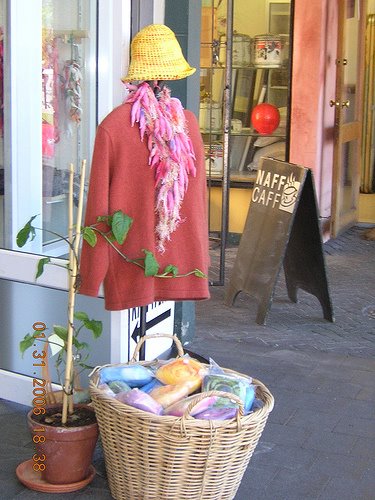
In the basket are handdyed rovings in little plastic bags. Chiyo uses Ashford dyes.

Wednesday, February 01, 2006

Kiwi Gifts, the LYS

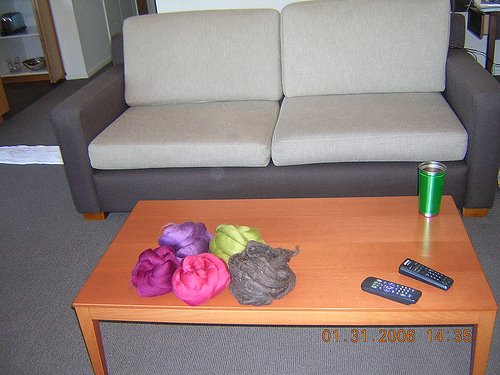
I went to see Veronica of Kiwi Gifts, the local yarn shop in Queens- town. It was from Veronica that I bought my first spinning wheel, an Ashford Kiwi, in March 2005. She sells mostly yarns and knits and no spinning wheels, but will order from the manufacturer on request. Last year she carried Corriedale fiber, but this year, her fibers are mostly merino, dyed and natural. On the coffee table are a sampling of the merino fiber, my first purchase in NZ this year.

Tuesday, January 31, 2006

Arrival in Queenstown

Thirty-six hours since leaving Cabin John, we are finally in Blue Peaks Apts. First things first: set up that Little Gem.

Sunday, January 29, 2006

Off to Queenstown, NZ

Saturday, January 28, 2006

Impromptu Spinning Classes

Learned to spin ingeo, bamboo, and soy silk with Sylvia. This is the class I will miss in February due to travel. Later joined two others to learn about spinning cotton.

Tuesday, January 24, 2006

Fiber Study @ Springwater Fiber

First of the three-class course with Sylvia Del Mar. Tonight was devoted to spinning camel, llama and alpaca fibers.

Thursday, January 19, 2006

My 15 minutes of fame @ The New York Times

Thursday Styles section

January 19, 2006
The New Spinners: Yarn Is the Least of It (Excerpt)

By ELIZABETH OLSON

THERESE CRUZ is a newcomer to the ancient art of spinning, and she is hooked. She began learning to spin last June, already has two imported wooden spinning wheels and is getting ready to buy an even nicer one.

"It saves me from being addicted to anything else," Ms. Cruz, said with a laugh as she pressed her bare feet, one after the other, against wooden pedals and steadily fed puffs of colorful fleece into her turning wheel.

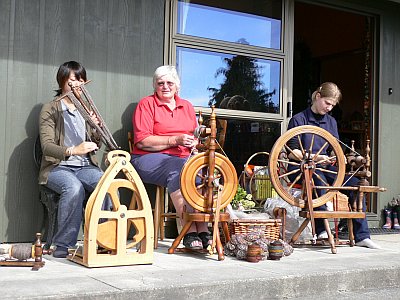
She and a dozen other avid spinners had gathered at a fiber workshop in Alexandria, Va., in early January to celebrate St. Distaff's Day, the ancient English holiday when household chores resumed after the 12 days of Christmas. The spinners had come with their own wheels, from large wooden machines to small Indian charkhas, and were diligently producing yarn thick and thin, colorful and plain, wool and silk.
"It is like taking a trip," Ms. Cruz said. "It is so tranquilizing to do this at the end of a day."
Randy Scheessele, who sat beside Ms. Cruz at the gathering, held at the Springwater Fiber Workshop, was making yarn on a drop spindle, an early spinning method that relies on a dowel topped by a hook, a piece of wood or even a CD. "When you come home after a day's work," said Mr. Scheessele, an economist at the Department of Housing and Urban Development, "spinning helps you wind down."

Spinning's under-the-radar growth can be found in the details. For example Ms. Cruz, a senior program assistant at the World Bank who lives in Cabin John, Md., said she had to check Web sites vigilantly last year to find an opening in a beginner's class.

She was introduced to spinning last year at the Maryland Sheep and Wool Festival, a sprawling two-day gathering each May that draws 60,000 people to watch sheep-shearing and herding, to buy bags of fleece and yarn and to choose among hundreds of spinning wheels of every shape, size and price.

"I knew right away I had to learn," Ms. Cruz recalled.